Happy March! Below is an update on my recent snow and ice ride-along, as well as an update on the midblock infill vote at Council.
Snow and Ice Ride-Along
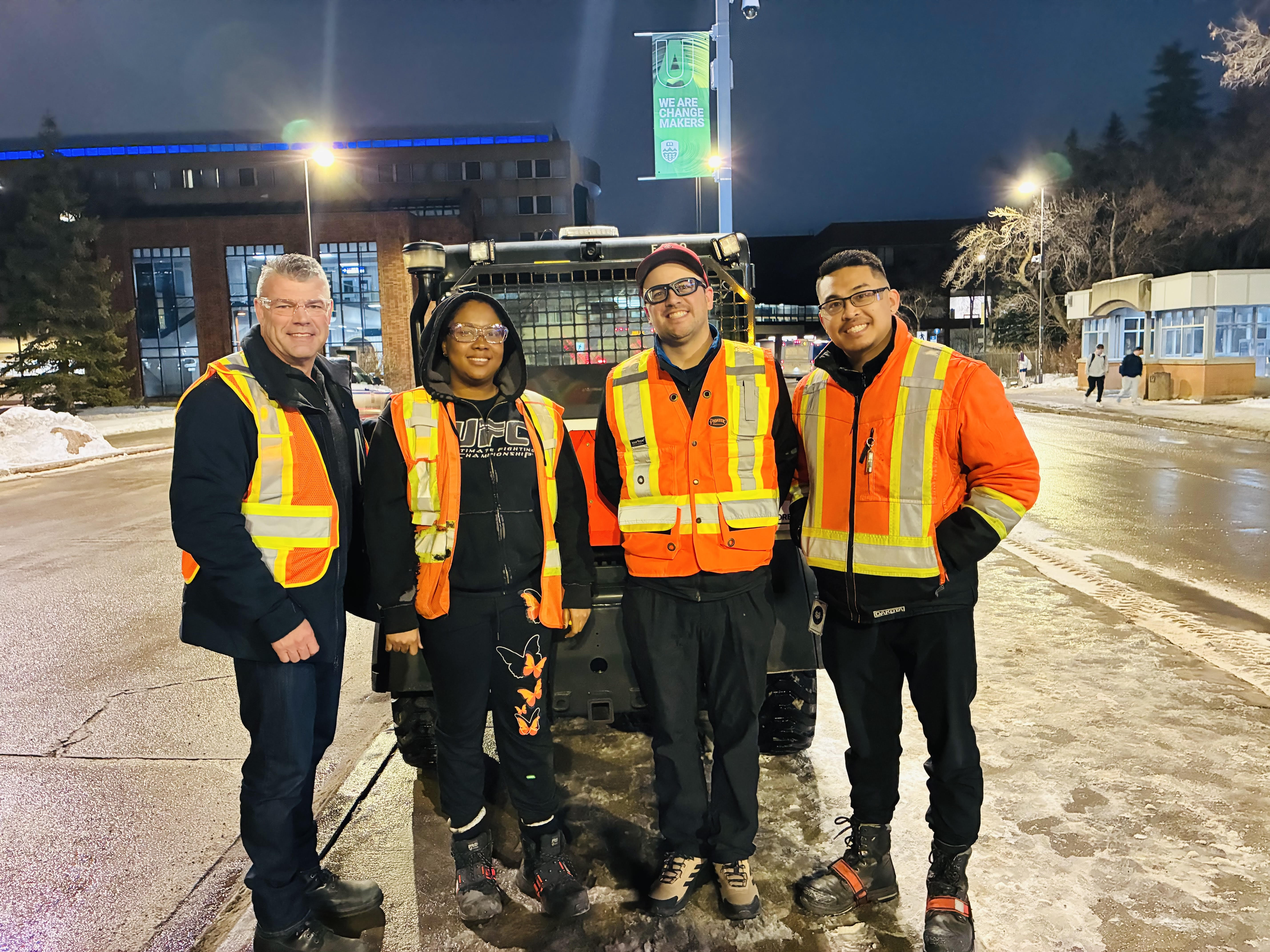
In my January update, I mentioned my meeting with the snow and ice crew and my commitment to participate in a ride-along. Understanding the experiences and challenges of our frontline workers is essential to identifying necessary improvements for our city.
I am pleased to report that I participated in this ride-along last week, visiting the Strathcona, Lendrum, Queen Alexandra, Landsdown and Greenfield areas. In our city we have 11.547 lane km of roads, 5773 km of sidewalks and 871 km of trails.
Our city employees are working diligently, and I sincerely appreciate their work ethic and commitment to clearing our streets and active pathways. I would also like to thank them for taking the time to engage with me.
Below are the key takeaways from our discussions. Please note that these comments come directly from our frontline staff. They are simply sharing their perspectives with me and do not necessarily reflect my own views.
- Do not use calcium chloride. It contributes to accelerated corrosion of vehicles and causes deterioration of pavement, concrete surfaces, and bridge expansion joints. It can also create slippery driving conditions. Additionally, it becomes ineffective at temperatures below approximately -15°C and may refreeze under extreme cold conditions.
- Calcium Chloride appears to perform adequately on high-speed roadways such as Anthony Henday Drive, where traffic volumes and speeds assist with product activation. However, it is less effective on lower-speed urban roadways. There are also concerns regarding its environmental impact, including potential harm to animals.
- Anti-icing treatments must be applied within a 24 hour window to be effective.
- Bike lanes present operational challenges for snow clearing. Roadways with bike lanes on both sides are narrowed considerably, making them difficult to navigate and maintain during winter operations.
- An example of bike lanes posing a challenge is the bike lane configuration along Saskatchewan Drive to Whitemud Drive creates significant snow-clearing difficulties. In addition, some bike lanes, such as 76 Avenue between Gateway Boulevard and Calgary Trail, are constructed too narrowly to accommodate standard maintenance equipment (e.g., skid steers), limiting the City’s ability to clear snow effectively. This reflects design limitations that should be addressed.
- Traffic calming measures create additional complications for winter maintenance. When snowfall exceeds approximately six inches, many of these features become obscured, increasing operational difficulty and potential safety concerns.
- Curb extensions near crosswalks interfere with drainage patterns, often leading to water accumulation and icing.
- Consideration should be given to elevating bike lanes and separating them from the roadway surface. Raised, protected bike lanes would improve functionality and reduce winter maintenance conflicts.
- At-grade bike lanes frequently accumulate windrows during plowing operations. Removing snow from these areas often requires additional equipment and resources, reducing overall efficiency.
- Authorizing automated traffic enforcement on snowplow vehicles would improve compliance with parking bans. This would allow for the capture and issuance of citations to vehicles obstructing snow-clearing operations.
- More education is needed to the Public regarding the Noise Bylaw. City Employees working at night are exempt from it.
Based on this recent feedback, it is clear that frontline workers are finding certain bike lanes and traffic calming measures challenging to maneuver. Additionally, I share the concerns many of you have expressed regarding the use of calcium chloride. I believe this substance is harmful and, as a result, I am unlikely to vote in favor of its continued use should the matter come before City Council.
I also want to address the ongoing challenges with windrows. I have received many calls and emails regarding windrows blocking entryways and the issues caused by freezing and thawing cycles. These concerns will be a priority for me during our upcoming snow removal discussions in August and budget deliberations in November and December.
To prepare for these conversations, my office will host a town hall meeting specifically focused on snow removal. This will be an opportunity for you to share your feedback directly with me. We will provide an update once the meeting is scheduled, so please watch for future emails and monitor my social media channels for details.
My office continues to compile your feedback and concerns. Please be assured that I am listening and working to identify how we can make snow removal more efficient for our city.
Infill Update
In February, Council discussed some potential changes to midblock infill (middle of a block, not at an intersection) and I would like to share an update on each of the items that we discussed.
Councillor Principe brought forward the following amendments;
- A decrease in the maximum number of dwellings on interior sites from 8 to 6.
- An increase in the maximum site area per dwelling for interior sites from 75 m2 to 90 m2.
I voted in favour of these amendments, with the hopes that these modest changes would alleviate some of the concerns residents are facing when an infill project enters their neighbourhood. Unfortunately, this was defeated so these changes will not be going forward.
The following items were passed and will be going to public hearing for further discussion and public input;
- That Administration: Prepare draft amendments to the Zoning Bylaw, Section 2.10 RS - Small Scale Residential Zone to reduce the maximum building height (Section 4.1.6) to 9.5 metres and return to Public Hearing for Council consideration.
- Create a private tree bylaw to protect trees during development and redevelopment through the demolition permit process and return to Public Hearing for Council consideration.
I was pleased to vote in favour of each of these items, which I think are a step in the right direction to ensuring constituents are being heard.
I do hope to have more opportunities in the future to challenge this Bylaw and hopefully bring forward some additional changes, such as an increase in the minimum set back requirements and a reduction in the maximum size of a building in proportion to the size of the lot. I have seen far too many infill projects which are too big for the lot and completely overshadow the neighbouring houses which is unacceptable.
While I’m not fully satisfied with the outcome of the discussion, I do want to reassure my constituents that I am fighting for you every step of the way, and I have heard you loud and clear that the current Zoning Bylaws are not working. I’m looking forward to future discussions where I hope meaningful change can take place that better support the needs of our City.
Please continue to connect with my office at [email protected] should you have any future concerns.